

Buy Physical Copy At:


The King of Kings
Licensor Information
Modern Sound Pictures Inc.
Directed by: Cecil B. De Mille
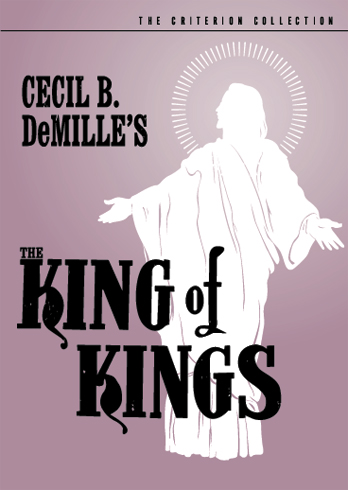
The King of Kings is the Greatest Story Ever Told as only Cecil B. DeMille could tell it. In 1927, working with one of the biggest budgets in Hollywood history, DeMille spun the life and Passion of Christ into a silent-era blockbuster. Featuring text drawn directly from the Bible, a cast of thousands, and the great showman’s singular cinematic bag of tricks, The King of Kings is at once spectacular and deeply reverent—part Gospel, part Technicolor epic. The Criterion Collection is proud to present this beloved film in a two-disc edition featuring both the 112-minute general-release version and the rarely seen 155-minute cut that premiered at the grand opening of Grauman’s Chinese Theatre.
Details by Film
The King of Kings
Extended VersionYear: 1927
Time: 155
Aspect Ratios
1.33:1
Audio
Musical Score Dolby Digital Mono 1.0
Musical Score Dolby Digital Stereo 2.0
Musical Score Dolby Digital Surround 5.1
The King of Kings
General ReleaseYear: 1928
Time: 112
Aspect Ratios
1.33:1
Audio
Musical Score Dolby Digital Mono 1.0
Musical Score Dolby Digital Stereo 2.0
Musical Score Dolby Digital Surround 5.1
Streaming Options








Release Information:
Technical Specifications
Format:
DVD
Discs:
DVD-9 (2 Discs)
Total: 2 Discs
Regions:
1/2/3/4/5/6 (DVD)
Aspect Ratio:
1.33:1
Audio Options:
Musical Score Dolby Digital Mono 1.0
Musical Score Dolby Digital Stereo 2.0
Musical Score Dolby Digital Surround 5.1
Resolution:
480p/29.97
Subtitles:
English
Supplements
Types of Supplements Included: Behind the Scenes Footage, Gallery, Theatrical Trailer, Booklet
- Behind-the-scenes footage from the making of The King of Kings
- Cast portraits by photographer W.M. Mortensen
- Production and costume sketches by renowned artist Dan Sayre Groesbeck
- Stills gallery of rare production and publicity photos
- Original illustrated program and press book featuring photographs from the film’s gala premiere at Grauman’s Chinese Theatre and studio correspondence from DeMille
- Original theatrical trailers
- Booklet featuring a 1927 essay by Cecil B. De Mille, an excerpt from Robert S. Birchard’s book Cecil B. DeMille’s Hollywood, production notes, and a new essay by film critic Peter Matthews
Forum Member Statistics
Sign-in with your forum account to rate this release
Film
Picture
Audio
Supplements
Artwork
Release Credits
Artwork: Eric Skillman
Producer: Kate Elmore
Release Notes on Restoration
The King of Kings
The King of Kings (1927) is presented in its original aspect ratio of 1.33:1. On widescreen televisions, black bars will appear on the left and right of the image to maintain the proper screen format. Certain intertitles were resized so that the entire text frame would be visible on all TV screens. This new high-definition digital transfer, encoded for optimal image quality onto a dual-layer DVD-9, was created on a Spirit Datacine by combining the best elements of two surviving 35mm archival prints, held by George Eastman House and the Cecil B. DeMille estate. The newly created 35mm internegative from UCLA’s original two/strip Technicolor nitrate print is the best surviving material for the color sequences, but despite digital restoration, severe fading and color imbalance remain. Thousands of instances of dirt, debris, and scratches were removed using the MTI Digital Restoration System.
The King of Kings
The King of Kings (1928) is presented in its original aspect ratio of 1.33:1. On widescreen televisions, black bars will appear on the left and right of the image to maintain the proper screen format. The cropping of the left side of the frame is inherent in the 1928 film materials and results from the addition of the optical soundtrack. This new digital transfer, encoded for optimal image quality onto a dual-layer DVD-9, was created on a Spirit Datacine from a 35mm fine/grain positive and a 35mm interpositive for the color sequences. Thousands of instances of dirt, debris, and scratches were removed using the MTI Digital Restoration System. The soundtrack was mastered at 24-bit from a 35mm optical soundtrack negative, and audio restoration tools were used to reduce clicks, pops, hiss, and crackle. The Dolby Digital 1.0 signal will be directed to the center channel on 5.1-channel sound systems, but some viewers may prefer to switch to two-channel playback for a wider dispersal of the mono sound.