

Buy Physical Copy At:


The Lower Depths | The Lower Depths
Licensor Information
Toho Co., Roissy Films
Featuring: Jean Gabin, Toshiro Mifune, Suzy Prim, Isuzu Yamada, Junie Astor, Kyoko Kagawa, Vladimir Sokoloff, Ganjiro Nakamura, Louis Jouvet, Koji Mitsui, Robert Le Vigan, Kamatari Fujiwara, Akemi Negishi, Minoru Chiaki, Nijiko Kiyokawa, Eijiro Tono, Eiko Miyoshi, Kichijiro Ueda, Haruo Tanaka, Bokuzen Hidari
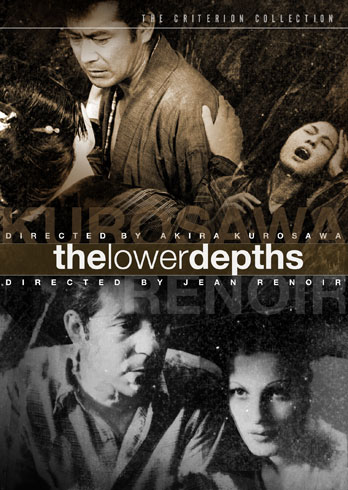
Jean Renoir and Akira Kurosawa, two of cinema’s greatest directors, transform Maxim Gorky’s classic proletariat play The Lower Depths in their own ways for their own times. Renoir, working amidst the rise of Hitler and the Popular Front in France, had need to take license with the dark nature of Gorky’s source material, softening its bleak outlook. Kurosawa, firmly situated in the postwar world, found little reason for hope. He remained faithful to the original with its focus on the conflict between illusion and reality—a theme he would return to over and over again. Working with their most celebrated actors (Gabin with Renoir; Mifune with Kurosawa), each film offers a unique look at cinematic adaptation—where social conditions and filmmaking styles converge to create unique masterpieces.
Details by Film
The Lower Depths
Year: 1936
Time: 89
Aspect Ratios
1.33:1
Audio
French Dolby Digital Mono 1.0
Streaming Options


The Lower Depths
Year: 1957
Time: 125
Aspect Ratios
1.33:1
Audio
Japanese Dolby Digital Mono 1.0
Streaming Options
Stream
2
Release Information:
Technical Specifications
Format:
DVD
Discs:
DVD-9 (2 Discs)
Total: 2 Discs
Regions:
1 (DVD)
Aspect Ratio:
1.33:1
Audio Options:
French Dolby Digital Mono 1.0
Japanese Dolby Digital Mono 1.0
Resolution:
480p/29.97
Subtitles:
English
Supplements
Types of Supplements Included: Audio Commentary, Documentary, Introduction, Text, Theatrical Trailer, Booklet
- Audio commentary on Kurosawa’s The Lower Depths featuring Japanese-film expert Donald Richie (A Hundred Years of Japanese Film)
- A 33-minute documentary on Kurosawa’s The Lower Depths from the series Akira Kurosawa: It is Wonderful to Create, including interviews with Akira Kurosawa, actress Kyoko Kagawa, art director Yoshiro Muraki, and others
- Introduction to Jean Renoir’s The Lower Depths by the director
- Cast biographies for Kurosawa’s The Lower Depths by Stephen Prince, author of The Warrior’s Camera: The Cinema of Akira Kurosawa
- Original theatrical trailer for Kurosawa’s The Lower Depths
- Booklet: New essay by Keiko McDonald (From Book to Screen: Modern Japanese Literature in Films) and Thomas Rimer (A Reader’s Guide to Japanese Literature) for the Kurosawa film; new essay by film scholar Alexander Sesonske, author of Jean Renoir: The French Films 1924-1939, for the Renoir
Forum Member Statistics
Sign-in with your forum account to rate this release
The Lower Depths
The Lower Depths
Picture
Audio
Supplements
Artwork
Release Credits
Producer: Kim Hendrickson
Artwork: Lucien S. Y. Yang
Release Notes on Restoration
The Lower Depths
The Lower Depths: Jean Renoir's The Lower Depths is presented in its original theatrical aspect ratio of 1.33:1. On widescreen televisions, black bars will appear on the left and right of the image to maintain the proper screen format. This new digital transfer was created on a Spirit Datacine from a 35mm composite print. Thousands of instances of dirt, debris, and scratches were removed using the MTI Digital Restoration System. The soundtrack was mastered at 24-bit from an optical track, and audio restoration tools were used to reduce clicks, pops, h'ss, and crackle. The Dolby Digital 1.0 signal will be directed to the center channel on 5.1-channel sound systems, but some viewers may prefer to switch to two-channel playback for a wider dispersal of the mono sound.
The Lower Depths
The Lower Depths: Akira Kurosawa's The Lower Depths is presented in its original theatrical aspect ratio of 1.33:1. On widescreen televisions, black bars will appear on the left and right of the image to maintain the proper screen format. This new high-definition digital transfer was created on a Spirit Datacine from a 35mm composite print. Thousands of instances of dirt, debris, and scratches were removed using the MTl Digital Restoration System. The soundtrack was mastered at 24-bit from an optical track, and audio restoration tools were used to reduce clicks, pops, hiss, and crackle. The Dolby Digital 1.0 signal will be directed to the center channel on 5.1 -channei sound systems, but some viewers may prefer to switch to two-channel playback for a wider dispersal of the mono sound.